Mouse
The Curious Incident of the Dog in the Night-TimeRats matter to Christopher as companions rather than as a category he accepts at a distance: he names his pet Toby, describes his habits, and plans carefully for his care when Christopher must leave home. Toby is both a familiar presence in Christopher’s room and a dependent animal whose needs shape the practical details of Christopher’s journey.
Toby as a Companion
When Mrs. Alexander asks whether Christopher would like a dog, he answers that he already has a rat and gives the animal a name: Toby. He explains that Toby washes himself, does not need to be taken out for walks, and can exercise by running around Christopher’s room. Sometimes Toby sits on Christopher’s shoulder or hides in his sleeve, which Christopher compares to a burrow while noting that rats do not live in burrows in nature.
Christopher also challenges the suspicion that rats are unclean. He attributes their bad reputation to their association with sewers and ships, then contrasts that image with Toby’s own grooming. His description is affectionate but also particular: Toby is not an abstract example of an animal, but a named companion whose routines and preferences Christopher observes closely.
Care and Practical Needs
Christopher knows what Toby eats and what he must avoid. He says Toby can eat special pellets as well as biscuits, carrots, bread, and chicken bones, but that chocolate is poisonous to rats in large quantities. Toby also needs fresh water in his bottle every day. Christopher distinguishes between what is necessary for the animal’s care and what is optional: Toby likes to come out of his cage, but it is not essential that someone let him out.
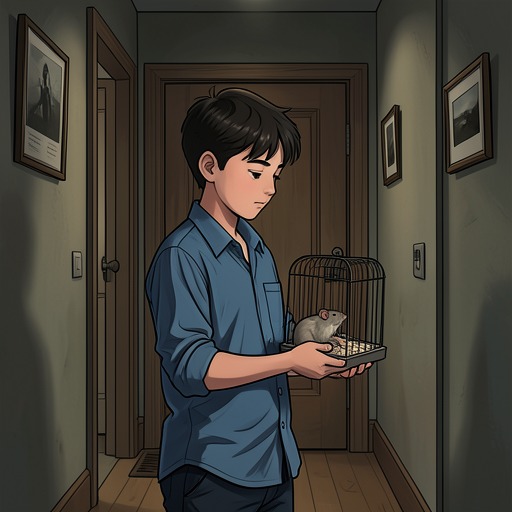
This practical knowledge becomes important when Christopher decides to go to London. He carries Toby’s cage downstairs while his father is asleep, covering it with a coat to quiet the scratching noises, and takes his special food box as well. The cage and food box are not incidental luggage: they show that Christopher’s escape plan includes keeping Toby with him and preserving the routines that make the animal safe.
Toby and the Journey to London
At Mrs. Alexander’s house, Christopher raises Toby’s cage to show her the rat and explains how to feed and water him. When she asks why someone needs to look after Toby, Christopher says he is going to London. The exchange makes clear that his request for help is bound up with the journey: he needs a temporary caregiver because he is leaving, not because his attachment to Toby has ended.
Toby’s dependence also places a concrete limit on Christopher’s plans. Christopher cannot simply leave without considering the animal’s food, water, cage, and temporary care. The rat therefore occupies a distinct place in the story: Toby is a companion with recognizable habits, while caring for him gives Christopher a familiar set of responsibilities to carry into an unfamiliar situation.
Narrative Significance
The account of Toby combines close observation with direct, practical care. Christopher attends to the details of the rat’s behavior and diet, and explains those details to another person in precise terms. The contrast between Toby’s reputation and Christopher’s account resists treating rats as interchangeable signs of dirt or danger; the relevant evidence is the particular animal Christopher knows and looks after.
Toby’s presence also connects home life with Christopher’s departure. In the quiet preparations to leave, Christopher takes the cage and muffles its noise rather than abandoning the animal. Later, his effort to arrange care for Toby makes his destination explicit. The rat thus links companionship to responsibility: Toby is not only someone Christopher wants beside him, but a living creature whose needs he continues to plan around.